Harassment is also one of the manifestations of discrimination in the workplace.
The Polish definition of harassment is included in the Labor Code, in Art. 18³a § 5. Pursuant to this provision, the following is also considered a manifestation of discrimination:
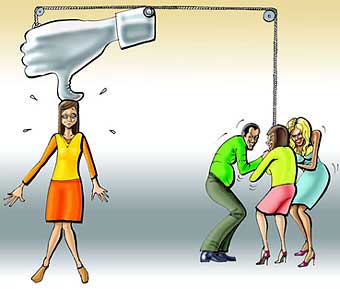
inciting another person to violate the principle of equal treatment in employment,
such behavior whose purpose or effect is to violate the employee’s dignity, as well as to humiliate or humiliate him.
This legal structure shows that the essence of harassment is, above all, the protection of the employee’s dignity. However, for a given behavior to be treated as a form of employment discrimination, it should not only cause the employee to feel humiliated, but also lead to a deterioration of his professional situation in relation to other employees.
It is also worth referring to the EU definition, according to which harassment means undesirable behavior whose purpose or effect is to violate a person’s dignity and to create an atmosphere of intimidation, hostility, humiliation, degrading or an offensive environment.
Although harassment may sometimes resemble mobbing, they are not the same. For a given behavior to be considered harassment, certain conditions must occur:
the conduct must be offensive and subjectively painful to the employee concerned; the opposition of the harassed person is also important,
it may even be a one-off behavior,
the assessment of this behavior should also be based on objective criteria that allow it to be considered that it violates the employee’s dignity,
the behavior should be humiliating and create an intimidating atmosphere,
its effect should be a violation of the employee’s rights in the field of employment.
Sexual harassment as a special form of discrimination
A special type of gender discrimination is sexual harassment.
This definition is contained in Art. 18³a § 6 of the Labor Code, according to which gender discrimination is any unacceptable behavior of a sexual nature or relating to an employee’s gender, the purpose or effect of which is to violate his dignity, humiliate or humiliate him. This behavior may include physical, verbal or non-verbal elements.
The most important feature of sexual harassment is that it is unwanted and unacceptable by the person to whom it is directed. In practice, it may take the form:
sexual suggestions,
demanding or expecting sexual benefits,
offensive flirting,
lewd innuendos,
inappropriate proposals.
The Commission of Experts on the Compliance of ILO Convention No. 111 also identified examples of behavior that may constitute harassment. These include:
insinuations,
inappropriate comments about age, clothing, hairstyle or family situation,
insults and insults,
telling inappropriate jokes
inappropriate glances,
showing pornographic materials.
It should be emphasized that this is an open catalog, so it does not cover all possible cases. At the same time, not all sexual harassment automatically means a violation of the principle of equal treatment in employment based on gender. Such a classification is only possible when the perpetrator’s behavior is also related to unacceptable differences in the employee’s situation.
Two forms of sexual harassment
Sexual harassment as a manifestation of gender discrimination may occur in two basic forms:
1. Creating a hostile work environment
A co-worker may also be the perpetrator of such behavior. It involves undesirable sexual interest directed at a specific person, which negatively affects their well-being and work efficiency.
The so-called „hostile environment” may manifest itself, among others: by:
a) undesirable sexual behavior, such as:
jokes and comments with sexual overtones,
inappropriate touching,
comments of a sexual nature,
presenting material with sexual content;
b) behaviors related to the employee’s gender, e.g.:
insults,
profanity,
comments on characteristics assigned to a given gender,
offensive remarks about limitations allegedly based on gender.
2. Sexual blackmail
The second form of sexual harassment involves making professional decisions conditional on meeting sexual expectations. The perpetrator here can only be the employer or the supervisor, i.e. a person who has influence on employment, promotion or maintenance of the job position.
Such blackmail may involve, for example, demanding „sexual favors” in exchange for:
employment,
remaining in position,
improving working conditions,
avoiding negative professional consequences.
It is this form that most directly affects the employee’s professional situation.
Protection in EU law
Protection against harassment and sexual harassment is also provided for in European Union law.
Directive 2002/73/EC indicates that sexual harassment is a situation in which Unwanted conduct of a sexual nature—verbal, non-verbal, or physical—that has the purpose or effect of violating a person’s dignity and creating an intimidating, hostile, degrading, humiliating, or offensive environment.
In EU law, this protection is closely linked to combating discrimination on grounds such as:
gender,
age,
race,
ethnic origin,
religion or belief,
disability,
sexual orientation.
This allows harassment and sexual harassment to be combated using legal instruments designed to protect against discrimination.
Compensation and Legal Liability
In the case of sexual harassment in the form of creating hostile working conditions, an employee who decides to pursue their rights in court must demonstrate that such conduct actually occurred.
In such a situation, the employer may be liable for:
violation of the obligation to respect the employee’s dignity and other personal rights (Article 11¹ of the Labor Code),
failure to ensure safe working conditions (Article 15 of the Labor Code).
Regardless of this, the injured party may also seek protection of their personal rights under Articles 23 and 24 of the Civil Code.
In the case of sexual harassment in the form of a „hostile environment” or a violation of the principle of equal treatment, the employee may seek compensation in court under Article 18³d of the Labor Code.
However, if the case concerns a situation in which the employee’s professional situation deteriorated, the burden of proof may shift to the employer. In such a case, the employer must demonstrate that its decision was based solely on objective grounds and was not the result of the employee rejecting a sexual advance.
Legal Basis
Provisions regarding harassment and sexual harassment are primarily found in:
The Labor Code of June 26, 1974, in particular:
Article 11¹ – obligation to respect the dignity and other personal rights of an employee,
Article 15 – obligation to ensure safe working conditions,
Article 18³a § 5 – definition of harassment,
Article 18³a § 6 – definition of sexual harassment,
Article 18³d – compensation for violation of the principle of equal treatment in employment;
The Civil Code of April 23, 1964:
Article 23 – protection of personal rights,
Article 24 – protective measures in the event of their violation; EU law:
Directive 2000/43/EC,
Directive 2000/78/EC,
Directive 2002/73/EC.

 english